








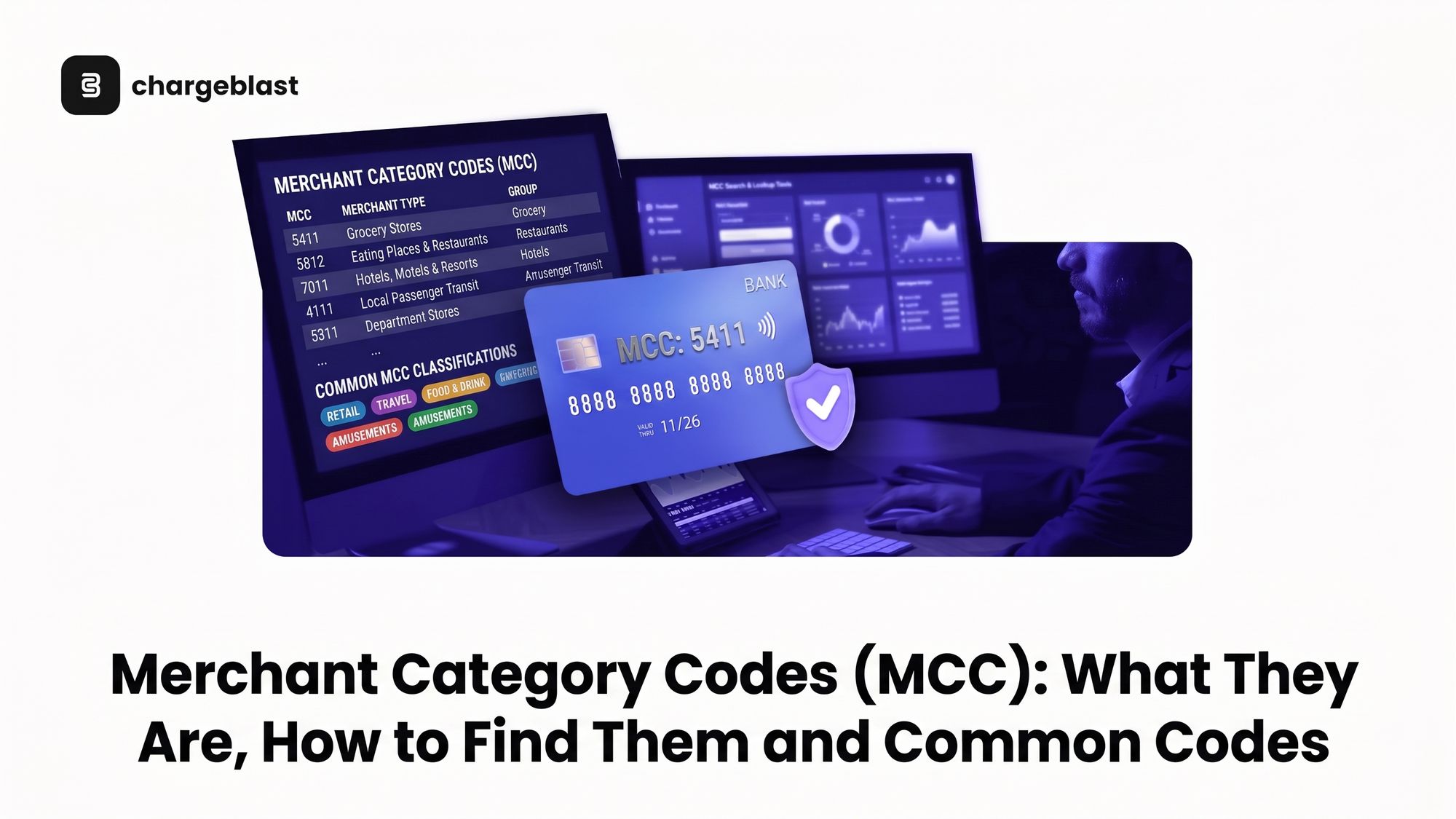
A merchant category code (MCC) is a four-digit number that tells the card networks what kind of business you run. Your acquirer or payment provider assigns it when your merchant account is set up, and it rides along with every card transaction you process. A restaurant usually sits under 5812. A grocery store sits under 5411. A SaaS company might land under 5734 or 5817, depending on how it sells.
It’s easy to forget your MCC exists. It starts to matter when something goes sideways: a pricing change you can’t explain, a processor review, or a payment program you can’t get into. So it’s worth knowing what your code is, who controls it, and what to do if it’s wrong.
Here’s the short version. You don’t pick your MCC from a menu. Your acquirer assigns it based on your primary business, the networks set the rules, and you can ask for a correction if your business doesn’t match the code.
What Is a Merchant Category Code?
Visa defines the MCC as a four-digit number assigned to describe a merchant’s primary business, based on annual sales volume. Some codes go further and identify a specific merchant or a specific type of transaction. Visa and its member banks use MCC data for activity tracking, reporting and risk management.
The code itself comes from an international standard. ISO 18245:2023 defines the code values used to sort merchants into categories based on the type of business, trade or service they supply. The networks build their own rulebooks on top of that standard, which is why Visa and Mastercard lists look very similar but aren’t identical.
It helps to separate the MCC from two other identifiers merchants mix up all the time:
Identifier | What it is | Who sees it |
Merchant category code (MCC) | A four-digit code describing your type of business | Acquirers, networks, issuers |
Merchant ID (MID) | A unique account number your acquirer gives your merchant account | Your acquirer and processor |
Billing descriptor | The name that shows up on your customer’s card statement | Your customers and their banks |
The descriptor and the MCC actually interact. Visa’s rules say that when a merchant name doesn’t match its MCC, the descriptor needs extra detail so the cardholder can tell what kind of business it is. Visa’s own example is a parking garage called John’s Farm, which has to show up as “John’s Farm Parking.” A clear descriptor helps cardholders recognize a transaction, so this small detail matters more than it looks.
Who Assigns Merchant Category Codes?
Your acquirer assigns your MCC. Not you, and not the card network directly. Visa’s manual calls it “an important requirement” that acquirers and their agents assign the correct MCC to each merchant. It also says Visa “retains the right to require corrections to MCC assignments and use.”
Here’s how the roles break down:
- Merchant: describes the business during onboarding (what you sell, how you sell it, where most of your revenue comes from).
- Acquirer: reviews that information and assigns the code. Mastercard’s booklet requires acquirers to provide “a valid and accurate MCC” and defines an accurate MCC as “a valid MCC that most reasonably and fairly describes the merchant’s primary business.”
- Payment facilitator: if you’re on a payment facilitator, it’s the one evaluating your business. Visa says a facilitator “must evaluate the business of every sponsored Merchant and assign the MCC most appropriate to the sponsored Merchant’s business.”
- Card network: publishes the code list and the rules, and creates new codes when a business type needs one.
That last part has a high bar. Mastercard, which calls MCCs “acceptor business codes,” publishes criteria for new ones. For a new generic code, one route is projected annual bankcard volume of at least USD 10 million for that code, plus a merchant type that’s distinct from other industries. Even when a request meets the criteria, Mastercard says it grants new MCCs at its sole discretion.
How Merchant Category Codes Are Determined
The rule of thumb is simple: your MCC should describe what you mainly do. Visa tells acquirers to pick the code that most accurately describes the merchant’s business, and in most cases that means the primary type of business the merchant is engaged in.
Things get interesting when you do more than one thing. Under Visa’s rules, a merchant with more than one line of business has two options:
- Use the MCC for the line with the highest sales volume (measured in local currency) for all Visa sales.
- Use a different MCC for each line of business.
Visa’s own example: a store that sells books, stationery and newspapers, plus a music CD section, uses 5942 (Book Stores) because books make up most of its sales.
A few other Visa rules worth knowing:
- “Miscellaneous” codes are a last resort. Codes that usually end in 99 should only be used when no specific MCC fits.
- Each outlet gets its own code. Merchants with multiple locations pick the right MCC for each one. An e-commerce site counts as a location on its own.
- Some codes describe how you sell, not what you sell. Direct marketing and wholesale club codes describe the business model. A direct marketing merchant can sell almost anything, but it has to use a direct marketing MCC.
- Big travel brands have their own codes. Airlines, car rental companies and hotel chains can have merchant-specific MCCs. In Mastercard’s Quick Reference Booklet (2 June 2026), codes 3000 to 3350 are airlines, 3351 to 3500 are car rental agencies and 3501 to 3999 are hotels and resorts.
Why does this matter? Because “primary business” sounds obvious until your revenue mix shifts. A salon that adds a day spa might find, a year later, that the spa brings in more money. Visa uses this exact case and says the merchant can either switch to the spa code or run the spa on its own terminal with its own code.
Common Merchant Category Codes
There are hundreds of MCCs. The table below covers 20 commonly used codes. The names are plain-English labels, not official network titles, and each network words its own descriptions a little differently.
MCC | Title |
4121 | Taxis and limousines |
4722 | Travel agencies and tour operators |
5310 | Discount stores |
5311 | Department stores |
5411 | Grocery stores and supermarkets |
5541 | Service stations (gas stations) |
5651 | Family clothing stores |
5732 | Electronics stores |
5734 | Computer software stores |
5812 | Restaurants |
5814 | Fast food restaurants |
5817 | Digital goods: software apps (excluding games) |
5912 | Drug stores and pharmacies |
5968 | Subscription and continuity merchants (direct marketing) |
5969 | Other direct marketers |
5999 | Miscellaneous and specialty retail |
7011 | Hotels and lodging (no brand-specific code) |
7372 | Computer programming and IT services |
7399 | Business services, not elsewhere classified |
8999 | Professional services, not elsewhere classified |
Want to look up a code that isn’t here? Chargeblast’s MCC lookup tool lets you search by number or business type. For official titles and network-specific lists, see our guides to Visa merchant category codes and Mastercard merchant category codes.
How to Find Your MCC
Your MCC isn’t secret, but it’s rarely printed somewhere obvious. Here’s where to look, roughly in order of effort:
- Your processor or payment dashboard. Many providers list the MCC under account, business or settings details.
- Your merchant statement. Some statements show the MCC near your MID or account summary.
- Your onboarding paperwork. The merchant application or agreement often records the code assigned at setup.
- Your acquirer or processor’s support team. Just ask. They have it on file and can confirm it in writing.
If you’re on a payment facilitator, remember that the facilitator assigned your code, so that’s who to ask.
Once you have the number, check it against the actual network list. Visa publishes its Merchant Data Standards Manual, and Mastercard publishes its Quick Reference Booklet. Read the full description, not just the title. Titles are short, and the descriptions tell you what’s actually included.
One more tip: write your MCC down internally, next to a sentence describing the business model it reflects. When your product mix changes six months from now, you’ll have something to compare against.
Are MCC Codes Universal Across Card Networks?
Partly. The numbering comes from ISO 18245, and some common codes overlap. 5411, for example, is grocery stores on both networks.
The differences show up in labels, coverage and rules:
Difference | Visa (Merchant Data Standards Manual, October 2026) | Mastercard (Quick Reference Booklet, 2 June 2026) |
What they call it | Merchant Category Code | Acceptor business code (MCC) |
Money transfer codes | 4829 Money Transfer | 4829 Money Transfer, plus 6536 MoneySend Intracountry and 6537 MoneySend Intercountry |
Brand-specific codes also vary. Visa adds them in dated editions of its manual. The October 2026 edition, for example, added merchant-specific codes 3884 to 3886 plus 3306 for Scoot. A brand can have a dedicated code on one network that doesn’t exist on the other.
Rules differ too. Mastercard requires a Transaction Category Code (TCC) in authorization messages, uses the TCC during stand-in processing, and says only a valid combination of MCC and TCC may be used in a transaction. Visa has its own list of mandatory multiple-MCC scenarios, covered below. So “universal” is the wrong word. “Shared foundation, network-specific rules” is closer.
Can a Business Have More Than One MCC?
Yes. Sometimes it’s optional, and sometimes the rules require it.
Visa lists several situations where a merchant must use more than one MCC:
- Automated fuel dispensers. Pay-at-the-pump sales use 5542. Anything else the station sells uses the right MCC for those sales, like 5541.
- Gambling. In card-present settings, gambling transactions use 7995 and other sales use their own code. Online gambling uses 7995 for all transactions, even when gambling isn’t the merchant’s main business.
- Separate businesses on the same premises. A coffee shop inside a supermarket with its own branding and its own checkout needs its own code. So does a hotel restaurant with its own name and point of sale.
- High integrity risk lines of business. If a merchant runs multiple lines of business in the same location and one of them is high integrity risk, Visa requires the high integrity risk MCC on that line and another MCC on the rest.
- Multiple e-commerce sites. When a merchant runs separate websites selling distinct goods or services, each site needs the MCC that fits it.
Then there’s the optional route. If you sell more than one type of product, Visa lets you run everything under your highest-volume line, or you and your acquirer can decide to add an MCC for each line of business. Visa also “strongly recommends” that assigned MCCs are reviewed periodically to ensure accuracy.
Can you just ask for extra codes to get a better rate on part of your sales? Not really. A second MCC needs a real second line of business behind it, usually with its own name, area, checkout or website.
What Happens If Your MCC Is Wrong?
A wrong MCC doesn’t always cause problems right away. When issues do show up, they tend to be about classification and process.
Here’s what can realistically happen:
- Visa or your acquirer corrects it. Visa’s manual says Visa “retains the right to require corrections to MCC assignments and use.” A correction can change how your transactions are categorized going forward.
- Invalid codes get rejected. Mastercard rejects First Presentment clearing messages submitted with an invalid MCC, with the error “DE26 ACCEPTOR BUSINESS CODE (MCC) INVALID OR OBSOLETE.” A valid code that’s just the wrong fit won’t bounce, which is exactly why it can sit there unnoticed.
- Your account gets reviewed. If your actual sales don’t match your code, this can come up during underwriting reviews or audits.
- Program eligibility shifts. Some network programs and rules key off the MCC. If your code is wrong, you might be inside or outside a program you shouldn’t be.
- Customers get confused. If your descriptor and MCC don’t line up with what customers think they bought, that’s friction you don’t need.
The bigger risk is deliberately using a code that doesn’t fit. Picking a “safer-looking” MCC to dodge scrutiny is misclassification, and it can create far bigger problems than the one you were trying to avoid. Get the right code, then manage the risk honestly.
How to Request an MCC Correction
If you think your code is wrong, the fix runs through your acquirer or processor. You can’t change it yourself. Here’s a simple way to handle it:
- Confirm your current MCC using one of the methods above.
- Find the code that fits better in the Visa and Mastercard lists. Read the full descriptions, not just titles.
- Pull together evidence. Your business description, your website, your product catalog and a rough breakdown of sales by product line all help.
- Contact your processor or acquirer and request a review. Explain what you sell, how you sell it and why the current code doesn’t fit.
- Get the outcome in writing. Ask whether anything else changes with the new code, like pricing or account terms.
- Recheck your first statement after the change to confirm the new code is live.
If your business type truly has no matching code, a new MCC is possible but rare. Visa’s manual has a dedicated section for this, Section 3: New MCC or MCC Change Requests. Mastercard points to its Acceptor Business Code (MCC) Request Form (Form 380) on Mastercard Connect, the portal it runs for its customer institutions. Either way, start with your acquirer.
Do MCCs Affect Fees, Rewards, Risk and Disputes?
They’re one input among many. That’s the honest answer, and anyone promising more is overselling.
Fees. Mastercard’s booklet describes its custom acceptor business programs as “unique groupings of MCCs used by the system for purposes of interchange qualification.” So your code can be one of the things that decides which interchange category a transaction lands in. Card type, how the card was accepted and transaction data also play a part. Changing your MCC won’t automatically lower your costs, and it might not change them at all. Our guide on how interchange fees work breaks the rest down.
Rewards. Issuers see the MCC on each transaction and can use it to sort purchases into spend categories. How a card handles that is up to the issuer, and it varies by card.
Risk. Visa’s manual names certain MCCs as high integrity risk for card-absent sales: 5122 (drugs), 5912 (drug stores and pharmacies), 5966 (outbound telemarketing), 5967 (adult content and services), 5993 (cigar stores), 7273 (dating services) and 7995 (betting). Six more, 4816, 5816, 5968, 6211, 6051 and 6012, are flagged only for specific card-absent transaction types. There’s also a regional condition. In the Asia Pacific, Canada, CEMEA, Europe, and Latin America and Caribbean regions, the 5912 and 5993 flags only apply if the merchant processes transactions other than domestic ones. Being in one of these codes isn’t a verdict on your business, but it does come with extra rules.
Disputes. Your MCC doesn’t decide whether a chargeback is won or lost. Evidence, reason codes and timing do. What your MCC does shape is the context: the kind of products you sell, how customers buy them and which dispute patterns tend to show up. We dig into that in how your MCC and business type affect disputes.
For the pre-dispute side, see how Chargeblast Deflection works.
Frequently Asked Questions
What is an MCC code?
An MCC code is a four-digit number that classifies a merchant by the type of business it runs. Your acquirer assigns it, and it travels with every card transaction. Card networks, acquirers and issuers use it for classification, reporting and risk management.
Who assigns my merchant category code?
Your acquirer, or your payment facilitator if you’re on one. Visa makes acquirers responsible for assigning the correct MCC and requires payment facilitators to evaluate every sponsored merchant and assign the most appropriate MCC. You can request a change, but you can’t set it yourself.
Are MCC codes universal?
Partly. The numbering is based on ISO 18245, so some common codes overlap on Visa and Mastercard. Labels, brand-specific codes and network rules can still differ. Always check the network’s current list for the exact description.
How often do MCC lists change?
Regularly. Visa publishes its Merchant Data Standards Manual in dated editions. The October 2026 edition added merchant-specific codes 3884 to 3886 and 3306 for Scoot, and moved escort services from 7273 to 5967. Check the latest edition rather than relying on an old copy or a third-party list.
Can I change my MCC to pay lower fees?
Not on its own. Your MCC has to reflect your actual primary business. If it’s genuinely wrong, ask your acquirer to correct it. If it’s right, switching to a code that doesn’t fit is misclassification, and fees depend on more than the MCC anyway.
Sources
- Visa, Visa Merchant Data Standards Manual (October 2026 edition). Sections used: Summary of Changes; Section 1, Determining a Merchant Name; Section 1, Determining Merchant Category Codes (General Requirements, Mandatory Multiple MCCs, Optional Multiple MCCs); Section 3, New MCC or MCC Change Requests. Retrieved 2026-11-09, https://usa.visa.com/dam/VCOM/download/merchants/visa-merchant-data-standards-manual.pdf
- Mastercard, Quick Reference Booklet: Merchant Edition (2 June 2026), retrieved 2026-10-22, https://www.mastercard.com/content/dam/mccom/shared/business/support/rules-pdfs/mastercard-quick-reference-booklet-merchant.pdf. Sections cited, all in the Acceptor business codes (MCCs) chapter:
- USD 10 million criterion for a new generic MCC: Acceptor business code (MCC) criteria (p. 50)
- Form 380, the Acceptor Business Code (MCC) Request Form: Acceptor business code (MCC) criteria (p. 50)
- “Most reasonably and fairly describes” the merchant’s primary business: Required use of MCCs (p. 51)
- Data Element 26 rejection of invalid MCCs: Required use of MCCs (p. 51)
- TCC requirement, stand-in processing and valid MCC and TCC combinations: Transaction Category Codes (p. 51)
- MCC groupings for interchange qualification: Acceptor business (AB) programs and descriptions (p. 54)
- Airline, car rental and lodging code ranges: Acceptor business codes (MCCs): extended, MCCs 3000 through 3350, 3351 through 3500 and 3501 through 3999 (pp. 78, 80, 81)
- MCC titles for 4829 Money Transfer, 6536 MoneySend Intracountry and 6537 MoneySend Intercountry: Acceptor business codes (MCCs): extended (pp. 99, 205, 206)
- International Organization for Standardization, ISO 18245:2023 Retail financial services: Merchant category codes, retrieved 2026-10-19, https://www.iso.org/standard/79450.html