







Chargeback prevention tools are the systems merchants use to stop disputes from happening in the first place, and to keep the ones that do start from becoming chargebacks. They don’t all work at the same moment. Some screen the order before the sale. Some make the charge easy to recognize, so the customer never calls their bank. Others step in after that call but before a chargeback is filed. Knowing where each tool acts, and where it stops, is how you build the right stack. The bigger strategy lives in our chargeback prevention guide.
Chargeback Prevention Tools at a Glance
Chargeback prevention tools fall into six types, and each one targets a different cause at a different point in the transaction. Here’s the quick map.
Tool Type | When It Acts | Primary Problem | Examples | What It Cannot Do |
Fraud screening and authentication | Before or during checkout | Stolen card and account takeover fraud | AVS, CVV checks, 3D Secure, device signals, velocity rules, fraud scoring | Generally prevent legitimate cardholders from disputing purchases later or resolve delivery and refund issues |
Transaction clarity and descriptor tools | After the sale, when the cardholder reviews the charge | “I don’t recognize this charge” disputes | Recognizable billing descriptors, digital receipts, Ethoca Consumer Clarity, Verifi Order Insight | Fix disputes about delivery, quality or refunds |
Pre-dispute alerts and resolution | After the cardholder contacts their bank, before a chargeback is filed | Disputes you would rather refund than fight | Ethoca Alerts, Verifi Rapid Dispute Resolution, Visa Resolve | Cover every issuer, or guarantee every alert ends without a chargeback |
First-party misuse and deflection tools | At the inquiry or pre-dispute stage | Repeat customers who claim fraud | Verifi Order Insight, Ethoca Consumer Clarity, Visa Compelling Evidence 3.0, Mastercard First-Party Trust | Help with true fraud or first-time buyers with no history |
Analytics and root-cause monitoring | Ongoing, across all disputes | Repeating dispute causes you never fixed | Reason code reporting, dispute dashboards, product and channel breakdowns | Stop a single dispute on its own |
Evidence and representment tools | After the chargeback is filed | Invalid chargebacks you can win | Evidence builders, representment workflows | Prevent anything. These are recovery tools, because the chargeback already exists |
Most merchants need more than one row. The trick is matching each row to the right cause.
Before the Transaction: Fraud and Authentication Tools
Fraud and authentication tools decide whether an order should go through at all. They target stolen cards and account takeover, which is where true fraud chargebacks come from. If your disputes are mostly “I didn’t make this purchase” from people whose cards really were stolen, this is your first layer.
The usual toolkit looks like this:
- AVS (Address Verification Service): compares the billing address the customer entered with the one the issuer has on file.
- CVV checks: confirm the shopper has the security code printed on the card.
- 3D Secure and other authentication: adds an issuer verification step. For eligible transactions, a successful authentication can shift fraud liability to the issuer under card network rules.
- Device and risk signals: look at device fingerprint, IP location, email age and other signals that hint at a bad actor.
- Velocity checks: flag lots of attempts from the same card, device or address in a short window.
- Fraud scoring: rolls all of that into a risk score, so you can approve, review or decline.
Here’s where they stop. These tools can’t reliably prevent first-party misuse. A legitimate cardholder can pass screening and still dispute the charge later. Authentication can still help, since depending on network rules it can affect liability or strengthen your evidence. And real customers can fail fraud checks or authentication too. Push screening too hard and you lose good orders that never show up in a dispute report.
After the Transaction: Clarity and Customer Communication
A lot of disputes start with confusion, not fraud. A customer sees a charge they don’t recognize, panics a little, and calls their bank. Clarity tools make sure the charge is easy to recognize and the order is easy to check, so that call never happens.
- Recognizable billing descriptors: your descriptor should match the brand name customers know, not a parent company or a legal entity name. Adding a support phone number or URL helps too.
- Receipts and order details: a clear confirmation email with what was bought, the amount and how to get help.
- Renewal and shipping communication: reminders before a subscription renews, plus tracking updates while an order is in transit. Surprise renewals and “where’s my package?” are classic dispute triggers.
- Transaction-data transparency: programs that put purchase details in front of the cardholder or issuer. Mastercard says Ethoca Consumer Clarity gives customers details such as digital receipts and subscription info right inside their bank app.
What can’t clarity tools do? They can’t stop someone who knows exactly what they bought and disputes it anyway. That’s a first-party misuse problem, and it needs a different tool.
Pre-Dispute Alerts and Automated Resolution
Pre-dispute alerts tell you a cardholder has already raised a problem with their issuer, so you can refund or resolve it before it turns into a chargeback. They’re the last prevention layer. They don’t stop every chargeback, but they give you a window to act that you wouldn’t otherwise have.
Our chargeback alerts guide goes deep on the networks. Here’s the short version, using how Visa and Mastercard describe their own programs:
- Ethoca Alerts (Mastercard): Mastercard says Ethoca Alerts “uses near real-time network data to flag disputes early” and connects merchants and issuers to share brand-agnostic dispute data. According to internal Mastercard data on its Ethoca Alerts page, Ethoca helped prevent more than 39 million chargebacks in 2025.
- Visa Resolve: Visa describes Resolve as a solution that “combines automated decisioning, manual refunds and real-time notifications.” Participating issuers create a pre-dispute case, it’s resolved based on rules you set, and the cardholder gets a refund. Visa reports 16.7 million pre-disputes processed in 2024. Visa’s post-purchase merchant page still lists Verifi Rapid Dispute Resolution, which auto-refunds pre-disputes based on customizable rules.
- Visa Dispute Resolution Network (VDRN): announced in April 2026. Visa describes VDRN as a unified solution that helps merchants resolve fraud and non-fraud pre-disputes, with real-time notifications and AI-powered decisioning.
- Verifi Order Insight (Visa): this one shares order details with the issuer while the cardholder is asking about a charge, so the question can be answered without a dispute. In Verifi internal reporting from October 2023 to September 2024, Visa says merchants deflected an average of 40% to 45% of confirmed first-party misuse disputes. As of an April 2026 update, merchants can also share Compelling Evidence 3.0 data through it. Our Verifi Order Insight guide covers setup and use cases.
A few limits to keep in mind:
- Coverage depends on the issuer. An alert only fires when the cardholder’s bank participates in that program.
- Response windows aren’t universal. They vary by program, network and setup. Check the current terms for each one instead of assuming a single deadline.
- A refund isn’t an automatic off switch. If the dispute has already moved forward, or the refund isn’t tied to the right case, a chargeback can still land.
Chargeblast’s chargeback alerts work at this stage.
Analytics and Root-Cause Detection
Analytics and root-cause tools tell you which prevention tool you actually need. They don’t stop a dispute on their own. They show you why disputes keep happening, so you fix the cause instead of paying to deflect the same problem forever.
Start by sorting every dispute by cause. Reason codes are a good first pass, but they’re not always accurate, so check the order history too.
Dispute Cause | What It Looks Like | Tools That Fit |
Fraud | Stolen card, unauthorized purchase | Fraud screening, 3D Secure, velocity checks |
First-party misuse | Real cardholder disputes a purchase they made | Order Insight, Consumer Clarity, strong evidence records |
Fulfillment | Item not received or not as described | Tracking updates, better product pages, ops fixes |
Cancellation or refund | Customer says they canceled or never got a refund | Clear cancellation flow, renewal reminders, faster refunds |
Descriptor confusion | “I don’t recognize this charge” | Descriptor fixes, transaction-data sharing |
Processing errors | Duplicate charge, wrong amount | Payment reconciliation, gateway and checkout fixes |
Track dispute ratios by cause and network over time. If one cause keeps climbing, that’s your next tool decision, not a mystery.
How to Choose the Right Prevention Tool
Choose a chargeback prevention tool by starting with your top dispute cause, then checking it against coverage, volume, effort and cost. The right tool for a subscription brand fighting friendly fraud looks very different from the right tool for a store hit by card testing.
Factor | What to Ask | Points Toward |
Dispute cause | Is it fraud, confusion, misuse or fulfillment? | Fraud: screening. Confusion: clarity tools. Misuse: CE 3.0 programs. Mixed: alerts plus analytics |
Processor and network coverage | Which processors, MIDs and card networks do you run? | Tools that cover both Visa and Mastercard across all your processors |
Transaction volume | How many disputes come in each month? | High volume: rules-based automation. Low volume: manual review may be enough |
Automation needs | Can your team act on every alert in time? | If not, automated refund rules |
Integration effort | How much dev time can you spare? | Tools that connect to your existing processor and order data |
False-decline risk | Are good customers getting blocked? | Lighter pre-transaction rules, more post-transaction tools |
Cost model | Per alert, per transaction or subscription? | Whatever maps cleanly to your dispute volume |
Reporting and root-cause visibility | Can you see why disputes happen? | Tools with reason code and product-level reporting |
Shortlisting vendors? Our comparison of chargeback prevention software covers that side. For the full strategy behind the stack, go back to the chargeback prevention guide.
Benefits of Chargeback Prevention Tools
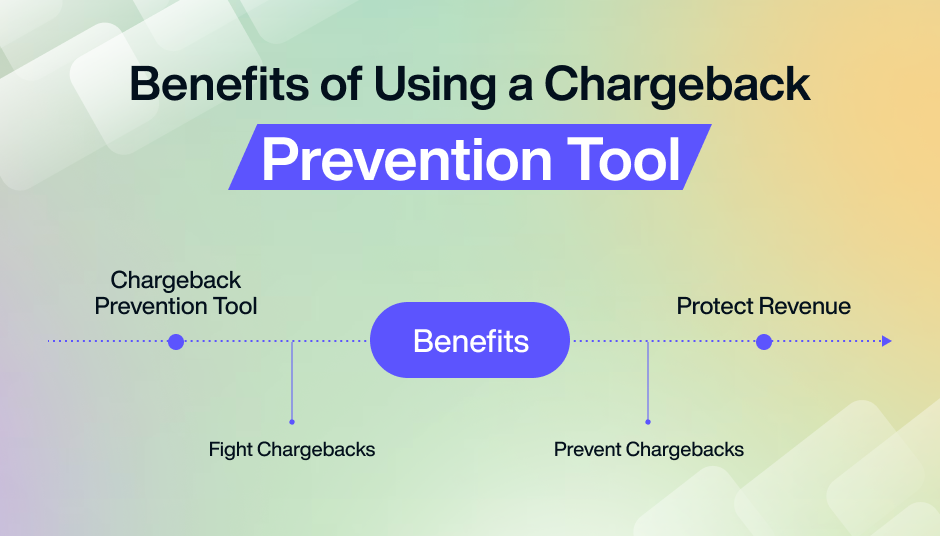
The benefits of chargeback prevention tools come down to catching problems earlier and spending less time on them. Results depend on your dispute mix, your coverage and how well you act on alerts, so there’s no universal savings number. Here’s what the networks themselves say these tools do.
- Revenue protection: On its Ethoca Alerts page, Mastercard says proactive dispute resolution can help “streamline operations, protect revenue and improve the customer experience.”
- Less manual work: Visa describes Rapid Dispute Resolution as a way to “reduce operational expenses and dispute ratios by auto-refunding pre-disputes based on customizable rules.”
- Faster intervention: Ethoca Alerts run on near real-time network data, so you can act earlier in the dispute process.
- Better visibility: Visa says that with Order Insight, “both issuers and customers can quickly access purchase details,” which makes confusing charges easier to recognize.
- Fewer unnecessary disputes: In its April 2026 announcement, Visa said Order Insight “helps prevent unnecessary disputes by surfacing transaction details.”
The common thread? Prevention tools work best stacked. Screening handles fraud, clarity handles confusion, alerts catch what slips through, and analytics tell you where to tighten next.
Frequently Asked Questions
What are chargeback prevention tools?
Chargeback prevention tools are systems that stop disputes from happening, or stop them from becoming chargebacks once they start. They include fraud screening and authentication before the sale, clear descriptors and receipts after it, pre-dispute alerts like Ethoca Alerts and Visa Resolve, deflection tools like Verifi Order Insight, and analytics that show why disputes happen. Each works at a different point in the transaction.
Do chargeback alerts prevent every chargeback?
No. Chargeback alerts only fire when the cardholder’s issuer participates in that alert program, and response windows vary by program. Even when you get an alert and refund, a chargeback can still go through if the dispute has already moved forward or the refund isn’t matched to the case. Alerts reduce chargebacks. They don’t guarantee zero.
What is the difference between prevention and representment?
Prevention stops a dispute before it becomes a chargeback. Representment happens after the chargeback is filed, when you send evidence to the issuer to try to reverse it. Representment is recovery, not prevention. It can win back revenue, but the chargeback still exists and can still count toward your dispute ratio.
Which tools help with friendly fraud?
Friendly fraud needs tools that work after the sale, since screening can’t reliably stop it. Verifi Order Insight and Ethoca Consumer Clarity share purchase details with issuers and cardholders. Pre-dispute alerts let you resolve claims early. Clear descriptors and receipts cut down “I don’t recognize this” claims. Visa Compelling Evidence 3.0 and Mastercard First-Party Trust help prove a purchase was legitimate.
What is the difference between chargeback prevention tools and chargeback management software?
Chargeback prevention tools work before a chargeback exists, either by stopping the dispute or by resolving it early. Chargeback management software usually covers the wider lifecycle, including alerts, reporting and representment after a chargeback is filed. Think of prevention tools as one part of the job, while management software tries to handle the whole process in one place.
Sources
- Visa, Preventing chargebacks, reviewed 2026-11-04, https://corporate.visa.com/en/solutions/acceptance/manage-disputes/prevent-chargebacks.html
- Visa, Next generation post-purchase solutions for merchants, reviewed 2026-11-04, https://usa.visa.com/solutions/post-purchase-solutions/merchants.html
- Visa, Dispute resolution, reviewed 2026-11-04, https://www.visa.com/en-us/support/business/dispute-resolution
- Visa, Order Insight, reviewed 2026-11-04, https://www.visa.com/en-us/products/order-insight
- Visa, Manage pre-disputes with Resolve, reviewed 2026-11-04, https://www.visa.com/en-us/products/resolve
- Visa, Visa Unveils New Services to Modernize Dispute Resolution Process (April 1, 2026), reviewed 2026-11-04, https://investor.visa.com/news/news-details/2026/Visa-Unveils-New-Services-to-Modernize-Dispute-Resolution-Process/default.aspx
- Visa, Resolve issues earlier to help avoid chargebacks (Visa Dispute Resolution Network), reviewed 2026-11-09, https://www.visa.com/en-us/thought-leadership/risk-fraud/resolve-disputes-earlier
- Visa, Visa Dispute Resolution Network (VDRN), reviewed 2026-11-09, https://www.visa.com/en-us/products/visa-dispute-resolution-network
- Mastercard, First-Party Trust, reviewed 2026-11-09, https://www.mastercard.com/global/en/business/cybersecurity-fraud-prevention/identity/first-party-trust.html
- Mastercard, Dispute management and chargeback prevention, reviewed 2026-11-04, https://www.mastercard.com/us/en/business/cybersecurity-fraud-prevention/dispute-management.html
- Mastercard, Ethoca Alerts: Prevent Chargebacks in Real Time, reviewed 2026-11-04, https://www.mastercard.com/us/en/business/cybersecurity-fraud-prevention/dispute-management/ethoca-alerts.html